The Era of Anticipation: When News Made Us Wait
There was a time — not too long ago — when news had rhythm.
It came once a day through the morning paper, and once a week through television.
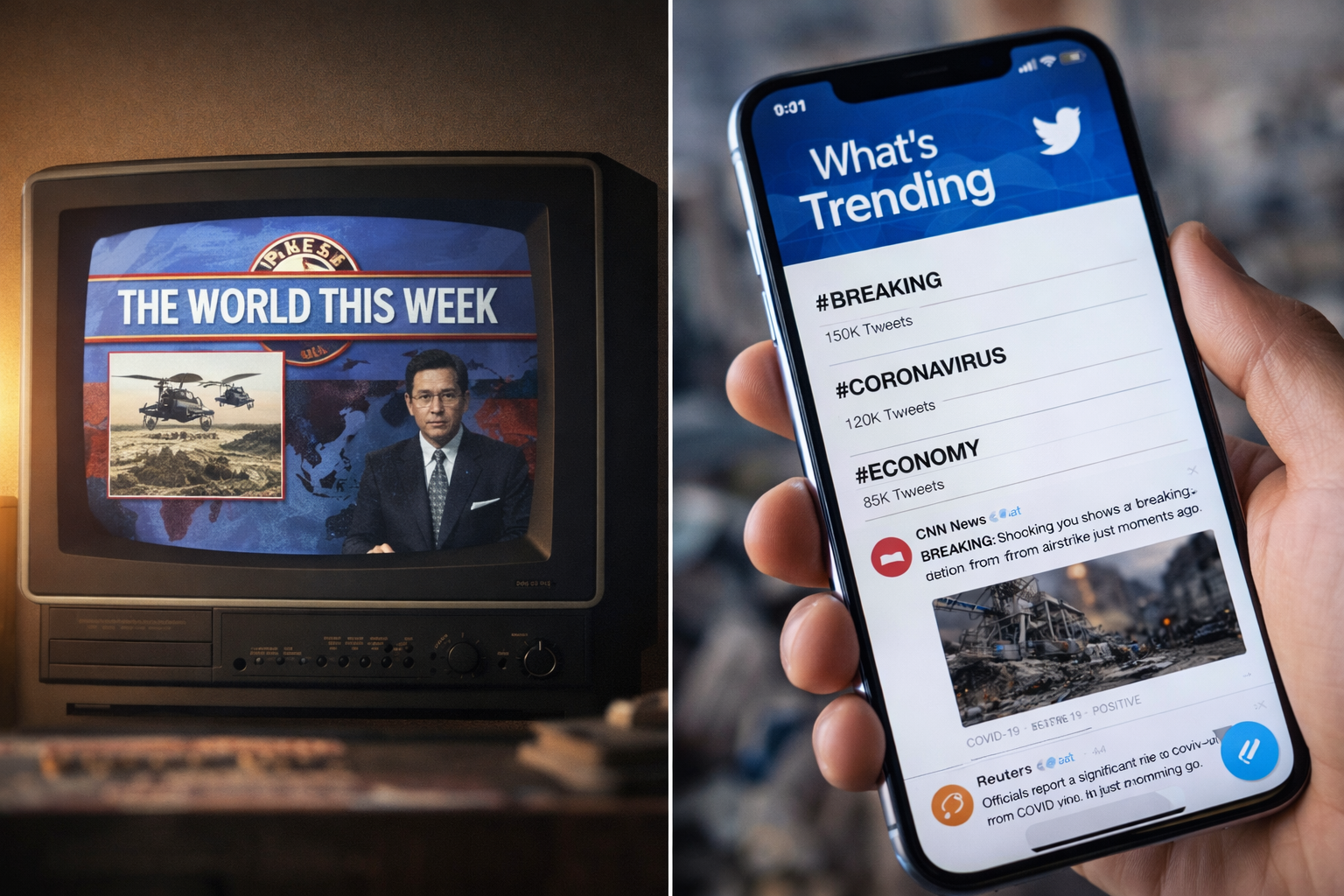
For millions of Indians in the late 1980s and early 1990s, Friday nights meant one thing: The World This Week on Doordarshan.
Curated and presented by Pritish Nandy, it wasn’t just another news show — it was India’s window to the world. From Cold War headlines to global culture and technology, it connected Indian viewers to stories far beyond our borders.
But the real magic lay in the waiting. Six days of anticipation for thirty minutes of perspective. Families gathered around a single screen, not for entertainment, but enlightenment. That collective pause — that shared curiosity — defined an era.
Television: The Age of Authority and Trust
Television in those decades wasn’t just a medium — it was the voice of truth.
Anchors were trusted, broadcasters respected, and viewers believed what they saw. Doordarshan, BBC, and CNN didn’t just inform; they defined narratives.
When The World This Week aired, households stopped to listen.
There were no hashtags, no notifications, no “Breaking” tickers every ten seconds. Just the calm, deliberate authority of television journalism.
But that authority came with a cost — it was a one-way conversation. Viewers watched, not responded. There was no feedback loop, no dialogue. Television spoke; the world listened in silence.
The Internet Cracks the Screen
The 2000s changed everything.
As the internet connected the world, it cracked television’s monopoly on storytelling. Blogs and online forums offered alternative voices. YouTube turned anyone with a camera into a broadcaster.
Then came social media — and with it, the great explosion.
Platforms like Twitter (now X) shattered the concept of the “news cycle.” The clock no longer ticked in hours or days — it ticked in seconds.
A protest, a flood, a celebrity scandal — it all unfolded in real-time. A single tweet could go viral faster than a TV crew could reach the scene.
In the age of The World This Week, the world arrived once a week.
In the age of Twitter, it never stops arriving.
From Anchors to Algorithms: The Power Shift
The most dramatic change wasn’t just speed — it was control.
In the television era, editors and producers decided what mattered.
In the Twitter era, algorithms and audiences do.
The World This Week reflected the world through a journalist’s lens.
Twitter reflects it through everyone’s lens messy, raw, emotional, democratic.
Breaking news no longer waits for the 9 PM bulletin.
It happens live — through hashtags, eyewitness videos, and viral reactions. Ironically, traditional media now takes cues from social platforms, not the other way around.
The Collapse of Waiting
Something subtle but powerful vanished in this transition — the act of waiting.
Once, we waited for the newspaper, the news hour, the Friday evening broadcast.
Now, waiting feels unbearable.
We’ve gone from scheduled storytelling to constant streaming.
From curation to chaos.
From anticipation to addiction.
And while instant updates keep us connected, they also leave us drained. There’s no pause, no reflection, no closure — only an infinite scroll.
Information Overload, Meaning Underload
When everything is breaking news, nothing feels truly new.
Twitter and social media have turned information into a flood. The urgency is intoxicating — but often, it comes without depth or verification.
The World This Week offered interpretation and perspective.
Today, feeds offer fragments — a thousand opinions without a pause for understanding.
As Pritish Nandy once said, “Information without interpretation is just data.”
In our digital age, we are drowning in data — but starving for meaning.
The New Gatekeepers: From Editors to Algorithms
Social media promised liberation — freedom from gatekeepers. Yet, the new gatekeepers are invisible.
Algorithms decide what trends, what fades, what shapes our worldview.
Where television had editors with ethics, algorithms have metrics.
They reward outrage, not accuracy; engagement, not empathy.
The anchor’s calm authority has been replaced by the trend’s volatile energy.
The Blend: Television Learns to Tweet
And yet, television didn’t die. It adapted.
Major networks stream on YouTube, tweet their headlines, and repurpose their shows for Instagram reels. The boundary between “TV” and “Twitter” has blurred.
The DNA of The World This Week connecting the local to the global — still survives.
Only now, it’s faster, louder, and infinite.
Pritish Nandy’s storytelling had context, credibility, and craft. That spirit lives on in today’s podcasts, newsletters, and digital documentaries — those that dare to slow down and tell the story behind the story.
The Return of Depth: Slow Journalism in a Fast World
As fatigue from endless updates grows, audiences are quietly rediscovering slow journalism.
Newsletters like The Ken, podcasts like The Daily, and digital explainers are bringing back what the internet took away perspective.
Just like The World This Week, they aim to connect the dots instead of just showing the dots.
We may scroll endlessly, but when we crave understanding, we still turn to storytelling — the kind that takes time.
From the Living Room to the Feed and Beyond
If The World This Week connected us through curiosity, Twitter connects us through participation.
We no longer wait for stories we shape them.
We share, react, argue, and amplify.
But maybe there’s something to learn from those quieter Fridays of the past.
News isn’t about speed; it’s about meaning.
When the noise feels overwhelming, perhaps we should remember that moment when millions sat together, watching a soft-spoken anchor unfold the world before them — not to chase trends, but to understand them.
Closing Thought
From The World This Week to What’s Trending Today, we’ve travelled from the age of anticipation to the age of acceleration.
The challenge isn’t just to stay informed — it’s to stay aware.
Because while platforms change, the purpose of journalism doesn’t:
To make sense of the world, one story at a time.