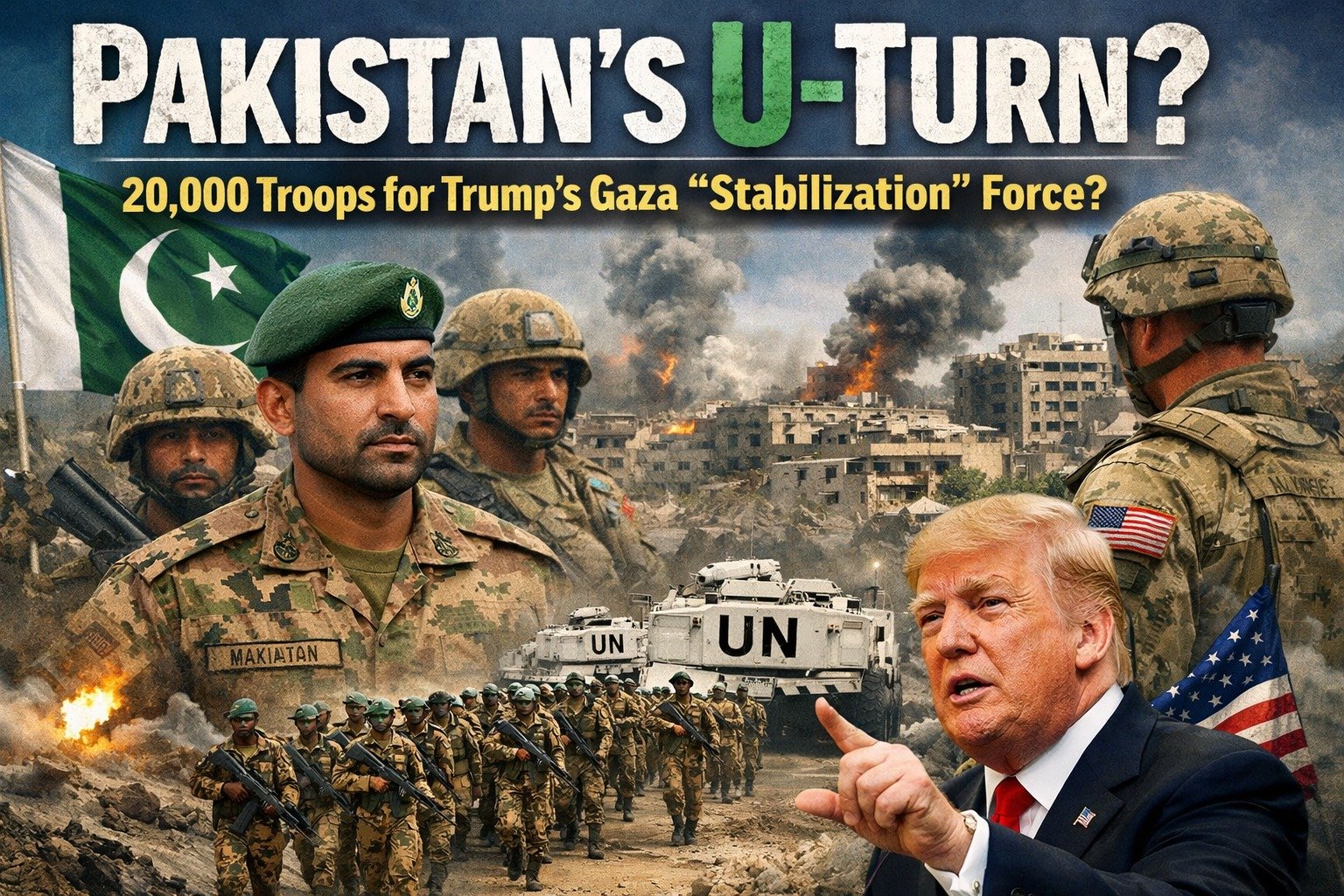
A startling narrative has emerged from recent reporting: a country that long styled itself as a champion of the Palestinian cause — Pakistan — is now being talked about as a potential contributor of ground forces to an international “stabilization” mission in Gaza. According to several media reports and intelligence-sourced stories, roughly 20,000 Pakistani troops could be part of the multinational contingent envisaged under President Donald Trump’s 20-point Gaza plan — a move that would mark a dramatic pivot in Pakistan’s foreign policy and trigger deep regional fallout.
The core claim — and where it comes from
Multiple outlets carrying intelligence-sourced material suggest Pakistan’s military leadership has held discreet talks with international intelligence partners about contributing troops to a temporary international stabilization force (ISF) for Gaza. Those reports say Pakistan’s contingent could number in the tens of thousands and would operate under the rubric of humanitarian aid, rehabilitation and security, but with a primary — and controversial — authorisation: neutralizing remaining Hamas elements in areas cleared of heavy fighting. Such coverage has cited anonymous officials, media reports and regional reporting.
At the same time, major international outlets and policy trackers note that Washington is actively planning for an international stabilization presence as one pillar of the 20-point Gaza plan, and that the U.S. is engaged in talks with several Muslim-majority countries about participation — while insisting it will not place U.S. combat troops on the ground in Gaza itself.
Why this would be a dramatic reversal
For decades Pakistan publicly refused to recognise Israel and regularly voiced political and diplomatic support for the Palestinian cause. The idea that Pakistani troops — uniformed soldiers of a nation that long framed itself as a Muslim world interlocutor — might be deployed in Gaza under an international mission closely coordinated with U.S. and Israeli planners would constitute a major policy reversal. Analysts say such a move would signal Pakistan’s willingness to trade symbolic solidarity for tangible geopolitical and economic gains offered by Western partners.
The official plan behind it
President Trump’s 20-point Gaza framework includes immediate ceasefire steps, return of hostages, and a transition phase in which an international stabilization force helps secure the enclave while local governance arrangements are put in place. The stated objectives of the ISF in public documents are security, protection of civilians and enabling reconstruction — but policy documents and commentators also emphasise that the plan explicitly aims to “deradicalize” zones of Gaza and prevent future militant reconstitution. That aim is politically fraught and would determine what any deployed troops are actually asked to do.
Why some reports say the ISF’s mission will include neutralising Hamas
Several intelligence-sourced articles claim that, beyond security and reconstruction, parts of the ISF’s operational remit would focus on dismantling remaining Hamas military infrastructure and disarming fighters — tasks that verge on offensive counter-insurgency operations. Those descriptions help explain why some countries would be reluctant to join, and why the composition of the force is so sensitive: many Arab and Muslim states fear domestic blowback if they are seen as taking sides against Palestinian factions.
Regional pushback and diplomatic consequences
The idea of Muslim-majority troop contributors is politically delicate. Turkey, Qatar and Iran — all of which have had ties, channels or sympathy with Hamas to varying degrees — have already signalled deep reservations about any plan that would actively target Hamas or place certain countries in a policing role. Israel, for its part, has signalled it will exclude some actors it deems hostile from participation. Jordan’s monarch and other Arab leaders have also publicly warned that enforcement of a ceasefire is complicated and unlikely to attract willing enforcers in the region. Any Pakistani participation would inflame those tensions and risk diplomatic ruptures with states that view this as betrayal.
What Pakistan would stand to gain — and lose
Media coverage interprets possible Pakistani participation as transactional: in exchange for taking on a difficult, controversial role in Gaza, Islamabad could secure debt relief, concessional finance or other international economic support from major Western and Gulf actors seeking to underwrite the plan. But the political costs are meaningful: domestic backlash from a public that traditionally sympathises with Palestinians, alienation of partners such as Turkey, and the risk of Pakistan becoming tied to operations whose legality and humanitarian consequences will be fiercely contested.
How credible is the reporting?
At present, reporting on a 20,000-strong Pakistani deployment relies heavily on anonymous sources and regional outlets citing intelligence or “people briefed on the matter.” Major wire agencies and policy centres confirm that planning for an international stabilization force is underway, and that multiple countries are in discussions — but they do not uniformly confirm specific troop numbers or the identities of all potential contributors. In short: the architecture of a multinational ISF is credible and verifiable; the scale and composition remain subject to negotiation and political resistance. Readers should treat specific figures and secret-meeting claims as plausible but not yet fully verified.
The bigger picture: politics, optics and the future of Gaza
If Pakistan, or any Muslim-majority state long associated with the Palestinian cause, joins an ISF tasked — even partly — with dismantling Hamas, it would reshape narratives across the Muslim world about who speaks for Palestine. It would also spotlight how fragile ceasefire and reconstruction politics are: international mandates, local legitimacy, and on-the-ground control will clash repeatedly. The ISF’s ultimate effectiveness will depend less on troop numbers and more on political buy-in from Palestinians, neighbouring states, and major powers — all of which remain deeply fractured.
Conclusion — cautious watch, high stakes
The claim that Pakistan will send 20,000 soldiers to Gaza — if it comes to pass — is a historic pivot with profound geopolitical, domestic and moral consequences. Even the prospect of such participation has already injected new tension into an extremely volatile diplomatic environment. For now, the international stabilization force concept is real and actively discussed; the exact cast of contributors, their mandates, and the political bargains underpinning them are still being forged. Observers should monitor official statements from Islamabad, Washington and regional capitals, and treat intelligence-based reporting with careful scrutiny as events unfold.
—
Sources used: reporting and policy pieces from Reuters, AP, Politico, Council on Foreign Relations and recent regional media pieces summarising intelligence-sourced claims.