Introduction
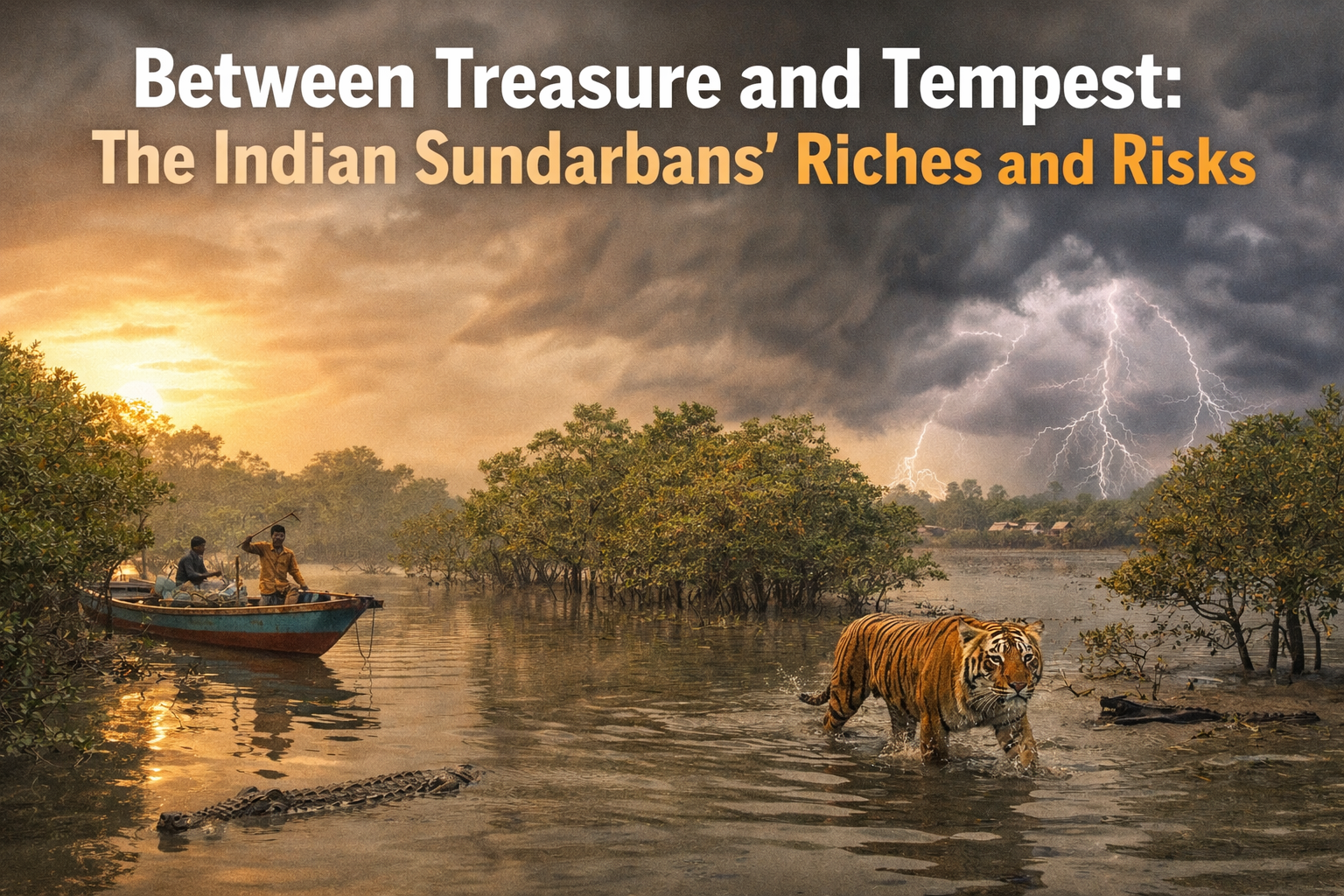
The Indian Sundarbans, a UNESCO World Heritage Site and the world’s largest contiguous mangrove forest, stands at a critical crossroads. This vast deltaic labyrinth – formed by the Ganges, Brahmaputra, and Meghna rivers – spans roughly 10,000 km² (with about 40% of this area in India). It is an ecological treasure of global importance, harbouring some 78 mangrove species (the richest diversity in the world) and iconic wildlife like the Bengal tiger, estuarine crocodile, river dolphins, and rare turtles. The Sundarbans’ mangrove thickets serve as a formidable natural shield – stabilizing shores, nurturing fisheries, storing carbon, and buffering cyclone storm-surges. At the same time, this region is home to approximately 4.5 million people on the Indian side (out of ~7.2 million across the whole transboundary Sundarbans). These are among the most economically marginalized communities in South Asia, living in remote island villages where development indicators lag and daily life remains entwined with nature’s whims.
Today, the Sundarbans epitomizes a stark dichotomy. On one hand, it offers immense ecological value, fertile soils and waterways, a rich carbon store, and opportunities for sustainable enterprise – a “blue economy” boon. On the other hand, it faces a convergence of intensifying climate threats and socio-economic challenges that endanger its very existence. The same mangroves that sustain livelihoods are now besieged by rising seas and stronger cyclones. The same communities enriched by deltaic bounty are increasingly impoverished by disaster losses, forced migration, and even human trafficking in the shadow of desperation. This report takes a comprehensive, narrative-driven look at the Indian Sundarbans through this dual lens of riches and risks. It examines the region’s natural wealth and potential, the cascading hazards imperilling it, and – crucially – the path forward. The tone is both qualitative and urgent: grounded in scientific evidence and local realities, yet focused on action and hope. With a timeline of milestones to 2030 and 2035, we outline what must be done – by governments, private sector, civil society, and communities alike – to secure a resilient future for the Sundarbans. Ultimately, the story of the Sundarbans is one of human-natural interdependence. How India navigates this delta’s challenges in the next decade will not only decide the fate of millions of Sundarbans residents and countless wild species, but also provide lessons for climate adaptation globally. The time for concerted action is now – to safeguard an irreplaceable treasure and avert a gathering tempest.
Ecological Riches of the Indian Sundarbans
Despite its challenges, the Indian Sundarbans remains a place of astounding ecological and economic value. Understanding what is at stake begins with recognizing these unique riches:
- Mangrove Forest and Biodiversity: The Sundarbans is the largest mangrove forest on Earth – a lush green tapestry where land and sea intertwine. Over one-third of this forest lies in India, comprising critical habitat for a dazzling array of life. The mangroves themselves include dozens of tree species specially adapted to saline, tidal conditions – from the towering Sundari (Heritiera fomes) that gives the Sundarbans its name, to dense tangles of Avicennia and Sonneratia with stilt roots and pneumatophores poking above the mud. These mangroves form a living bulwark against erosion and storms, their roots literally holding the delta together. They also sustain incredible biodiversity: the Sundarbans supports the single largest population of Bengal tigers in the wild, a population uniquely adapted to swim between mangrove islands. Other endangered fauna include estuarine crocodiles, Gangetic river dolphins, olive ridley sea turtles, king cobras, and hundreds of bird species. The food web is rich – from phytoplankton and mangrove detritus that nourish fisheries, to deer and wild boar that roam the forest floor, up to apex predators like the tiger and crocodile. Such biological wealth underpins both a vibrant ecosystem and the natural resource base for local livelihoods (fisheries, honey collection, wood, etc.). The Outstanding Universal Value of this biodiversity is recognized globally. Protecting it is not just an environmental priority but also vital for cultural heritage and long-term sustainability of the region.
- Carbon Sink and Climate Regulation: Mangrove forests are often called “blue carbon” hotpots for their remarkable ability to capture and store carbon dioxide. The Sundarbans’ vast mangrove biomass and peaty soils form a significant carbon sink, mitigating climate change. Each hectare of healthy mangrove can sequester substantial amounts of CO₂ annually, outperforming many terrestrial forests in carbon uptake. This creates an opportunity for the region to tap into carbon finance. By conserving and restoring mangroves, India can generate verified carbon credits – tradable units of emissions reductions – which in turn can attract climate funding and corporate investment. Blue carbon credits from mangrove projects command premium prices (often US$15–35 per ton or more) on global voluntary markets, given their multiple co-benefits for biodiversity and communities. The Indian Sundarbans, with its extensive mangrove cover, is poised to benefit from this carbon economy. For example, the Government of India launched the MISHTI initiative in 2023 (Mangrove Initiative for Shoreline Habitats & Tangible Incomes), aiming to restore 540 km² of mangroves in five years across India. A significant portion of these efforts will focus on Sundarbans sites. If designed well, such projects could not only bolster the natural storm protection for villages but also generate carbon credit revenues to be shared with local communities. In essence, the Sundarbans’ trees are not just guardians against storms – they are also valuable assets in the fight against global warming, potentially paying for their own protection through carbon finance mechanisms.
- Productive Fisheries and Aquatic Resources: The meeting of freshwater and tidal flows in the Sundarbans has created fertile aquatic habitats. Marine and estuarine biodiversity here is extraordinarily high – the mangrove-lined creeks and mudflats serve as nurseries for shrimp, crabs, and fish that sustain both local consumption and commercial markets. Traditional fishing communities have long derived sustenance and income from the delta’s fisheries, catching species like hilsa (ilish), prawns, crabs, and various finfish that migrate between the mangrove creeks and the Bay of Bengal. The Sundarbans is essentially a gigantic breeding ground that supports coastal fisheries well beyond its boundaries. Additionally, inhabitants collect wild honey from mangrove flowers and cultivate fish in brackish ponds. The region’s deltaic soils, enriched by silt deposits, historically supported rice farming and coconut groves on higher ground. With proper management, there is scope for sustainable aquaculture and agriculture that works in harmony with the mangrove ecosystem. For instance, controlled pisciculture (fish farming) and crab fattening in contained ponds can provide steady income if done without destructive practices. Innovative models like integrated mangrove-aquaculture (silvo fisheries) show promise – where mangroves are replanted around fish ponds to stabilize banks, improve water quality, and provide habitat, thereby boosting yields naturally. The fertile soils of the Sundarbans’ inhabited islands, though challenged by salinity, can also be leveraged for climate-resilient crops (such as salt-tolerant rice varieties, pulse crops in dry season, or horticulture on raised beds). In sum, the interplay of land and water in this delta offers a base for diversified, sustainable livelihoods from fishing, farming and foraging – provided these resources are managed prudently.
- Eco-Tourism and Cultural Heritage: Beyond extractive use of resources, the Sundarbans holds great potential for eco-tourism and related services. Tourists are drawn to its mystique – the chance to journey by boat through emerald mangrove channels, to spot a tiger’s footprint on a mudbank, or to experience the culture of communities living in harmony with tides. In recent years, controlled tourism has developed in parts of the Indian Sundarbans (e.g. Sajnekhali Wildlife Sanctuary and Tiger Reserve areas), offering boat safaris and birdwatching. This can be expanded in a sustainable manner that educates and benefits local people. Community-based tourism – such as village homestays, guided nature walks by local youth, and showcasing traditional crafts or cuisines – can provide alternative income for families that might otherwise depend on risky livelihoods (like prawn-seed collection in crocodile-infested waters). Culturally, the Sundarbans is rich with folklore, from Bonbibi (the forest goddess) worship to unique boat-making and fishing traditions. There is scope to develop cultural tourism that celebrates this heritage, through local museums, interpretation centres, or festivals that attract visitors. Done responsibly, eco-tourism can create jobs (hospitality, guiding, transport) and foster a greater appreciation for conservation – turning the Sundarbans’ wild allure into an economic asset. The West Bengal government has recognized this, emphasizing eco-tourism and cultural preservation as key components of its vision for the Sundarbans. Any tourism must, of course, be tightly regulated to avoid disturbing wildlife or polluting fragile areas. But if managed under a carrying-capacity approach, tourism could become a pillar of a greener economy in the Sundarbans, bringing in revenue that funds conservation and local development.
In summary, the opportunities of the Indian Sundarbans are manifold. This single region provides ecosystem services worth billions – from carbon sequestration to storm protection – and holds untapped avenues for sustainable enterprise (blue carbon credits, fisheries, agroforestry, crafts, and ecotourism) that can improve local livelihoods. It is a living laboratory for nature-based solutions. However, fully realizing these opportunities requires confronting and mitigating the formidable risks and challenges that now plague the Sundarbans.
Rising Threats and Challenges
For all its natural wealth, the Indian Sundarbans today is extraordinarily vulnerable. A convergence of climate change impacts, environmental degradation, and socio-economic stresses has created a precarious situation. This section outlines the key risks and challenges facing the region – many of which are interrelated and compounding:
- Sea-Level Rise and Land Subsidence: One of the gravest threats is the encroaching sea. Global warming has led to accelerating sea-level rise (SLR) in the world’s oceans, and the Bay of Bengal is a regional hotspot where the trend is even more pronounced. Over 1993–2020, satellite data show the Bay’s mean sea level rose ~4.0 mm/year – faster than the global average of ~3.1 mm/year. The latest IPCC projections warn that under high-emission scenarios, global sea levels could rise 0.6–1.1 m by 2100, and multi-meter rise cannot be ruled out if polar ice sheets destabilize. For the low-lying Sundarbans, this is an existential concern. Even a 45 cm rise (the lower bound under moderate scenarios) would permanently submerge large areas of the delta. The situation is worsened by land subsidence – the gradual sinking of the ground. Parts of the Ganges-Brahmaputra delta, including the Indian Sundarbans, are naturally subsiding due to sediment compaction and tectonics. Human activities amplify this: decades of groundwater extraction and reduced sediment deposition (from upstream dams and embankments) have caused localized subsidence rates of several millimeters per year. When combined, the relative sea-level rise (RSLR) – sea rise plus land subsidence – in the Sundarbans far exceeds global mean SLR. A conservative estimate for Kolkata (just upstream of Sundarbans) is ~8.6 mm/year RSLR currently, more than double the world average. The delta’s protective mudbanks and islands are literally sinking as waters climb. Since the 1960s, about 210 km² of Sundarbans land has already been lost to the sea. Several small islands have vanished entirely from maps. Standing on these shores, one can observe tides creeping higher year by year, eroding embankments and swallowing farmland. Projections are dire: studies suggest that 42% to 80% of the current mangrove area in the Indian Sundarbans could be lost by 2100 due to the combined effects of sea-level rise and erosion. Such massive habitat loss would displace hundreds of thousands and destroy the ecosystem’s integrity. Thus, rising seas and sinking land form a twin-triggered trap for the Sundarbans, steadily increasing baseline inundation and setting the stage for worse flooding disasters.
- Intensifying Cyclones and Storm Surges: The Bay of Bengal has always bred tropical cyclones, but climate change is supercharging these storms. Warmer ocean surface temperatures and changing atmospheric patterns are leading to more frequent and severe cyclones striking eastern India. In the past few decades, West Bengal (and Bangladesh) have been pummelled by an onslaught of high-intensity cyclones – a trend clearly observed by scientists and local communities alike. Notably, in just the span of three years (2019–2021), five extremely destructive cyclones slammed into the Sundarbans region: Fani, Bulbul, Amphan, Yaas, and Jawad. This cluster of calamities has earned the Sundarbans the unfortunate moniker of “India’s cyclone capital”. Each storm brings howling winds and massive storm surges – walls of water pushed inland by cyclone winds. With the baseline sea level now higher, storm surges penetrate even deeper. During Cyclone Amphan (May 2020) – one of the strongest storms ever recorded in the Bay of Bengal – wind gusts over 200 km/h drove a surge that overwhelmed embankments and inundated large swaths of South 24 Parganas district. Amphan uprooted an estimated 15,000 trees in urban Kolkata alone and obliterated countless more in the Sundarbans; it caused a staggering $14 billion in damages in India and Bangladesh, and displaced tens of thousands of families overnight. The destruction of mangroves during Amphan was severe – one assessment found the dense mangrove canopy cover in the Indian Sundarbans dropped from about 77% coverage to just 34% after this one cyclone, due to defoliation and tree losses. A year later, Cyclone Yaas (May 2021) struck on a full-moon high tide, breaching “protective” embankments across the delta. Yaas’s surge flooded villages and ruined 221,000 hectares of crops, as saltwater washed over paddy fields, rendering them uncultivable in an acute case of salinity intrusion. Even weaker cyclones or depressions now cause outsized damage. The record shows a trend of rapid intensification – storms strengthening very quickly before landfall – which gives little time for evacuation and preparation. Communities report that events like simple high tides or non-cyclonic storm surges are also more unpredictable and damaging than in decades past, partly because mangrove belts have thinned and embankments are fragile. In sum, the hazard profile has escalated: what used to be occasional catastrophic cyclones are becoming a regular menace each pre-monsoon or post-monsoon season. The Sundarbans, as Bengal’s coastal shield, takes the brunt of these storms – but as the shield frays, areas further inland (including Kolkata) grow more exposed. The rising frequency of extreme cyclones constitutes a relentless pummelling of the Sundarbans, stretching recovery to a breaking point.
- Floods, Storm Surges and Salinity Intrusion: Beyond the dramatic cyclones, the Sundarbans faces “everyday disasters” in the form of frequent flooding, tidal inundation, and creeping salinity. Many of the inhabited islands sit barely 1–2 meters above mean sea level, crisscrossed by tidal creeks. High tides during the new moon and full moon routinely overtop aging embankments or seep through sluice gates, flooding fields and ponds. With climate change, even non-storm tidal flooding (so-called “sunny day” flooding) is getting worse. Villagers note that monsoon rains are becoming more erratic – long dry spells punctuated by intense downpours that overwhelm local drainage. When a heavy rain coincides with high tide, the water has literally nowhere to go, leading to prolonged waterlogging inside polders. The result is damage to homes (mud walls melt away), loss of standing crops, and contamination of drinking water sources. Crucially, salinity intrusion is a slow-moving disaster undermining the region’s agriculture and water supply. As sea levels inch up and dry-season river flows dwindle, saline water pushes further inland into the delta each year. Saline creek water seeps into the groundwater and onto farmlands, especially after embankment breaches. Over time, previously arable tracts have turned barren due to salt deposition. Farmers attempt adaptation – e.g. switching from rice to shrimp aquaculture in some areas – but shrimp farming often further degrades the land’s future productivity and mangrove cover. Currently, almost all shallow hand wells in the Sundarbans yield brackish water, forcing communities to rely on rainwater ponds or a few deep tubewells for drinking water. Freshwater scarcity is a growing concern. Women often walk long distances to collect potable water. Salinization also affects biodiversity: the keystone Sundari trees have been in decline, partly due to increased salinity and a disease known as “top dying” – their proportion in the forest has shrunk significantly. Overall, the interplay of flooding and salinity is eroding the delta’s fertility. Each flood brings a dose of salt that can ruin soil for the next planting season. Fish ponds get contaminated, killing freshwater species. Even infrastructure like roads and brick houses suffer as saline water corrodes foundations. These changes are painfully evident in places like Ghoramara or Mousuni islands where land is literally being lost chunk by chunk to estuary erosion and the remaining soil has become too saline for traditional crops. Such chronic environmental pressures diminish livelihoods gradually, in addition to the acute shocks of cyclones.
- Ecosystem Degradation and Biodiversity Loss: The Sundarbans’ ecological balance is under strain. Habitat loss is occurring not only from climate factors (erosion, submergence) but also from human pressures. Over decades, significant mangrove areas were cleared or degraded for settlements, rice farms, or fish ponds, especially on the fringes of the forest reserve. While core protected zones remain, the buffering mangroves around inhabited blocks have thinned in many locales, reducing the natural protection for villages. Deforestation has largely halted in recent years due to strict protections, but illegal resource extraction (timber poaching, overfishing, crab overharvesting) still happens, driven by poverty. Pollution is another concern: industrial effluents and untreated sewage from upstream (including Kolkata’s wastewater) flow down the Hooghly River into the Sundarbans, introducing toxins and plastics into delicate estuarine food chains. Oil spills from cargo ships or fishing boats occasionally foul the waters. Biodiversity is at risk as a result. The Bengal tiger population, for instance, faces not just poaching threats but also habitat shrinkage and reduced prey as humans encroach on prey species’ habitats. Marine fauna like river dolphins suffer from entanglement in fishing nets and noise from increased boat traffic. Recent scientific assessments warn of multiple potential tipping points: if mangrove loss and salinization reach certain thresholds, the ecosystem may not recover easily. A stark indicator was observed after Cyclone Amphan: remote sensing estimated that dense mangrove cover in the Indian Sundarbans dropped from ~77% to ~34% post-Amphan, suggesting that many large mangrove trees were damaged or defoliated. Although mangroves can regrow, the frequency of extreme events could outpace the forest’s natural regenerative capacity, leading to a permanent decline in forest quality. Furthermore, vanishing species are a concern – from the iconic Sundari tree to fauna like certain river terrapins and migratory birds. Conservationists note that several species once common are now rarely seen, indicating ecological stress. Every increment of biodiversity loss not only diminishes global natural heritage but also reduces the resilience of the Sundarbans (since a diverse ecosystem is better at buffering shocks). In short, the rich ecological tapestry of the Sundarbans is fraying, and with it, the life-support functions it provides to people are weakening. Halting this degradation is a race against time, requiring stronger protection and restoration efforts amidst very challenging circumstances.
- Livelihood Losses and Human Migration: The cumulative impact of the above environmental threats is a profound livelihood crisis for Sundarbans residents. Most families here rely on climate-sensitive livelihoods – small-scale farming, fishing, collecting forest products – all of which are becoming less viable. One major paddy crop a year was traditionally harvested, but now increasingly fails due to either flood, drought, or soil salinity. Fish catches in rivers have declined, pushing more people to venture illegally into core forest areas for crabs or to risk dangerous voyages to sea. Every cyclone or flood that hits destroys assets of the poor – homes, fishing boats, nets, livestock, standing crops – and many households never fully recover before the next disaster strikes. This has led to a pattern of distress-driven migration. Unable to sustain themselves, tens of thousands of Sundarbans inhabitants have left in recent years to seek work elsewhere. Some migrate seasonally (e.g. men going to Kolkata or other cities as day labourers, leaving families behind); others relocate permanently to the mainland. A 2015 survey by local officials estimated that about 100,000 people had moved out from 60 vulnerable island villages, with some island populations dropping 10–20% between 2001 and 2011. This “exodus” has likely continued and possibly accelerated after the devastating cyclones of the past few years. Indeed, recent estimates suggest as many as 1.5 million people have been displaced in the Sundarbans over the past two decades due to climate impacts – a massive wave of climate-linked migration. Those migrating are often the younger, working-age adults, leaving behind an increasingly vulnerable demographic of the elderly, women, and children in the villages. The migrants typically end up in slums or informal sectors of cities, facing precarious living conditions but feeling they had “no choice” as their ancestral lands became uninhabitable. On the flipside, small towns on the mainland fringe of the Sundarbans (like Canning, Jaynagar, Baruipur) have seen population booms of 40–60% in a decade from climate refugees arriving. This unmanaged migration poses new social challenges – from loss of cultural cohesion in source villages to unemployment and strain on urban infrastructure at destinations. It is a story of human insecurity: people of the Sundarbans, who are least responsible for climate change, are being forced to uproot and lose their traditional way of life because the environment can no longer support them. Ensuring safe, dignified migration pathways – as well as creating conditions for people to stay if they choose by improving local resilience – are both urgent priorities.
- Human Trafficking and Social Vulnerabilities: Perhaps the most tragic manifestation of the Sundarbans’ socio-economic vulnerability is the rise in human trafficking from the region. South 24 Parganas district (which contains much of the Indian Sundarbans) has consistently recorded among the highest incidences of trafficking in India. Impoverished families, shattered by disasters and with limited livelihood options, become easy targets for traffickers who lure or coerce women and children under false promises of jobs or marriage. Every major cyclone or flood tends to be followed by spikes in distress migration, during which traffickers prey on the desperate. Adolescent girls and young women are particularly at risk – many have been trafficked to distant states and forced into exploitative labor or sex work, a humanitarian crisis often underreported. Local NGOs and police have documented numerous cases and note that the climate crisis is amplifying this social crisis: as families lose their homes or breadwinners, their children become more vulnerable to exploitation. Traffickers exploit not only economic need but also lack of awareness. In many remote Sundarbans villages, education levels are low (female literacy remains alarmingly low in some blocks, e.g. surveys found 87% of women in certain livelihood groups were illiterate). This limits knowledge of the dangers and the legal rights available. Economic vulnerability + low awareness = high trafficking risk. The West Bengal government and NGOs have recognized this linkage; efforts are underway to form vigilance committees in villages, run awareness campaigns, and improve education and livelihoods for girls to cut off trafficking routes. However, the problem persists as a grave societal challenge. Each trafficked person’s story is a reminder that climate change is not just an environmental issue, but a human security issue – turning natural calamities into human tragedies. Combating trafficking in the Sundarbans context requires addressing its root causes: poverty, lack of local jobs, and the “push factor” of repeated disasters. In this sense, social ills like trafficking are interwoven with the environmental narrative. A failing environment fuels despair; despair opens the door to exploitation. Therefore, any holistic action agenda for the Sundarbans must integrate social protection, gender empowerment, and community awareness alongside physical climate resilience. Only then can the vicious cycle of disaster and human trafficking be broken.
In summary, the Indian Sundarbans faces a convergence of crises. Rising seas and stronger storms are literally redrawing the map of the delta. Salinity and erosion are stealing the fertility of the land. Biodiversity and mangroves are in decline under combined natural and human assaults. Livelihoods are collapsing, driving an exodus of climate refugees and exposing those who remain to predation and poverty traps. What was once a stable, self-sufficient estuarine society is now in the throes of upheaval – a frontline of climate change where the line between natural disaster and humanitarian disaster blurs. Yet, amidst these challenges, there are seeds of resilience. The next section will explore how the opportunities of the Sundarbans can be harnessed to counter these threats, and how a concerted strategy can turn this tide. The dichotomy of the Sundarbans – Treasure and Tempest – need not end in tragedy if proactive measures are taken. There is a narrow but viable pathway to sustain both the environmental security and human security of this remarkable region.
Opportunities for Sustainable Resilience
Confronted with the litany of challenges above, it would be easy to paint a purely bleak picture of the Sundarbans’ future. However, there are also powerful opportunities to pivot toward sustainability and resilience. The same natural systems that are under threat – mangroves, fisheries, the delta’s hydrology – can be part of the solution if protected and wisely managed. And the communities of the Sundarbans, though vulnerable, also possess traditional knowledge, adaptability, and a growing awareness that can be leveraged for positive change. This section highlights some key opportunity areas that, with investment and effort, can help secure a better future for the Indian Sundarbans:
- Mangrove Restoration and Blue Carbon Credits: Given the critical role mangroves play in buffering storms and storing carbon, large-scale mangrove restoration is a top opportunity that yields multiple benefits. Restoration means not just planting new saplings arbitrarily, but scientifically identifying suitable sites (e.g. mudflats or degraded forest patches) and helping mangroves regenerate there with community stewardship. The Government’s MISHTI program (2023) is a promising step, aiming to plant or restore 5,400 hectares (54 km²) of mangroves in West Bengal (and 540 km² nationally) in the next five years. To maximize success, restoration should follow best practices: favor native species, involve local villagers (especially women’s self-help groups) in raising mangrove nurseries, and ensure post-planting maintenance. A heartening model comes from some Indian Sundarban communities themselves – for instance, women in a pilot project on Rangabelia island established a profitable mangrove nursery, raising thousands of healthy saplings for plantation, while also producing mangrove-derived products like golpata palm syrup and keora fruit pickles for income. Such initiatives show how ecosystem restoration can be tied to livelihoods. On the financial side, as discussed earlier, connecting mangrove restoration to the voluntary carbon market offers a revenue stream. A properly verified Sundarbans mangrove restoration project could generate carbon credits for each ton of CO₂ sequestered, which companies (eager to meet climate targets) would purchase. This mechanism can fund ongoing conservation: one successful example is a community-led mangrove restoration in Myanmar that sold credits to international buyers and used the funds to build schools and clinics locally. For the Sundarbans, a similar approach could mean that global climate finance pays local people to be guardians of the mangrove forests. Additionally, protecting existing intact mangroves and preventing their conversion can generate “avoided deforestation” credits. By 2030 and beyond, a network of carbon-financed projects could cover much of the Sundarbans periphery, embedding mangrove preservation into the economy. The co-benefits are enormous: stronger storm protection, improved fisheries (as mangroves are fish nurseries), biodiversity conservation, and income for villages. In essence, restoring nature restores resilience, and the world is willing to invest in that if the mechanism is right. The opportunity now is to scale up these efforts rapidly, learning from past failures (e.g. mass mangrove plantings that saw low survival due to poor site selection) and incorporating community wisdom.
- Eco-Tourism and Heritage-Based Livelihoods: Eco-tourism, when done ethically, remains a bright opportunity for the Sundarbans. The allure of this unique mangrove world – with its wildlife and cultural mystique – gives it a strong ecotourism potential that could rival other global wetlands (like the Everglades or Mekong delta) if properly promoted. Already, a modest tourism sector exists (with a few resorts at the edge of Sundarbans Tiger Reserve and boat tours). By 2030, West Bengal could develop a comprehensive Sundarbans Ecotourism Plan focusing on sustainability and local benefits. This would involve training local youth as naturalist guides, improving homestay facilities in villages, and creating interpretive centres that educate visitors on mangrove ecology and climate challenges. The state government’s vision emphasizes responsible tourism and cultural preservation – for example, showcasing folk theatre about Bonbibi (the forest goddess) or traditional fishing methods to tourists can both generate income and keep cultural heritage alive. Eco-tourism could directly employ many locals as boat operators, guides, handicraft sellers, and hospitality providers, offering an alternative to exploitative work. Additionally, related small enterprises like craft cooperatives (producing mats from mangrove palm, wooden carvings, honey-based products, etc.) can find a market through tourism. There is also scope for academic tourism – researchers, students, and volunteers from around the world drawn to study the Sundarbans (from tiger biology to climate adaptation). With proper infrastructure (small research stations, tie-ups with universities), this could bring knowledge exchange and funding to the region. Crucially, any expansion of tourism must keep carrying capacity in mind to avoid disturbing wildlife or causing pollution – strict guidelines, limits on visitor numbers in core areas, and reinvestment of a share of tourism revenues into conservation (e.g. via local eco-development committees) are needed. If managed well, by 2035 the Sundarbans could be internationally known as a model for community-based ecotourism that uplifts local communities while protecting nature. This not only yields economic gain but also builds global awareness and support for Sundarbans conservation, turning tourists into advocates.
- Sustainable Fisheries and Aquaculture: The fisheries sector remains a lifeline and has untapped potential if made more sustainable. Currently, many fishing practices in the Sundarbans are low-yielding or harmful (e.g. catching juvenile prawn seedlings destroys other fish fry, and overfishing certain crabs is a concern). However, by introducing better resource management and technology, fisheries could provide more stable livelihoods. For example, community fishery cooperatives could enforce seasonal no-fishing zones in critical breeding areas to allow stocks to recover (similar to community-based fish sanctuaries in Bangladesh Sundarbans). The government and NGOs can assist by providing modern boat engines, cold storage, and market linkages so fishermen get better value for their catch. Aquaculture, if done in an eco-friendly way, is another opportunity. Brackish water aquaculture of species like mud crabs, shrimp, or even salt-tolerant fish (like tilapia) in controlled ponds can yield good income, but it must avoid the pitfalls of mangrove clearance and chemical use that characterized past prawn farming booms. New models like Mangrove Aquaculture Farms – where mangroves are planted around or within aquaculture ponds – can actually improve water quality and provide shade, increasing survival rates of stock. Training and initial capital are needed to help villagers adopt these methods. The government’s focus on pisciculture (fish farming) in its Sundarbans development plans is in line with this. By 2030, one could envision every Sundarbans island having a few demonstration farms operated by local entrepreneurs (with technical support from fishery experts), producing sustainable seafood. A push for certification (e.g. organic shrimp, mangrove-crab certified) could allow Sundarbans products to fetch premium prices on national and export markets. Moreover, allied activities like honey cultivation can be expanded – Sundarbans mangrove honey is famed for its unique taste; formalizing its harvest with cooperative processing and branding can raise incomes. The underlying principle should be to diversify livelihoods in harmony with the ecosystem: instead of monocrop paddy (increasingly risky), combine salt-tolerant cropping with fish culture (e.g. rice-fish rotation or shrimp-rice in sequence) and other activities like bee-keeping or weaving. Such diversification reduces risk – if one income source fails due to a climate shock, others may still provide sustenance. By 2035, with concerted effort, the goal would be a Sundarbans economy where no family is solely dependent on a single climate-sensitive livelihood; rather, through cooperative and innovative approaches, they draw from multiple streams – ensuring both economic resilience and reduced pressure on any one natural resource.
- Community Empowerment and Education: A cross-cutting opportunity that amplifies all others is investing in the human capital of the Sundarbans. Empowered, educated communities are better equipped to adapt and innovate in the face of change. One initiative described in the Sundarban Development Centre’s proposal is the creation of local educational resources – such as an illustrated Bangla book on climate and livelihood issues, climate-awareness exhibitions, and even a small weather monitoring and climate learning centre at a village school. These efforts aim to demystify science for local people and especially to engage women and youth in problem-solving. By spreading knowledge about sustainable practices (e.g. organic farming techniques, the importance of mangroves, how to prepare for cyclones), such programs can cultivate a new generation of “climate-literate” citizens. Women’s empowerment in particular is a game-changer: numerous studies show that when women are educated and have alternative livelihood skills, entire families and communities become more resilient. For instance, teaching women tailoring, handicrafts, or eco-tourism hospitality not only provides them income but also delays early marriages and reduces their dependency on risky jobs like prawn seed collection, which in turn can reduce their vulnerability to trafficking. Community-based organizations (CBOs) and NGOs in the Sundarbans have seized on this, forming women’s self-help groups and youth groups that engage in everything from mangrove planting to running cyclone shelters. Strengthening these grassroots institutions is a huge opportunity. By 2030, each village could have an active disaster management committee, a women’s savings group engaged in microenterprise, and a cohort of school students who participate in citizen science (like measuring local rainfall, or mapping high tide lines). Such social infrastructure greatly enhances the effectiveness of any external interventions. It also ensures that adaptation strategies are culturally appropriate and locally led, rather than top-down. The fight against human trafficking too hinges on community vigilance and awareness – village watch groups, community theatre skits that educate about trafficking tactics, and local radio messaging can all help inoculate the society against exploiters. All these measures might sound intangible compared to engineering projects, but they are indeed critical. A community that is well-informed, organized, and inclusive can recover faster from disasters and hold authorities accountable for support. The Sundarbans’ long history of collective spirit (e.g. communities traditionally helped rebuild each other’s homes after storms) can be built upon with modern knowledge and rights-based approaches. Thus, investing in people – through education, skills, and social capital – is perhaps the most foundational opportunity to secure the Sundarbans’ future.
In summary, while the threats are severe, the Indian Sundarbans also has a suite of opportunities to chart a new course. Mangrove restoration and carbon finance can turn the tide on environmental degradation while injecting funds locally. Eco-tourism and sustainable aquaculture can provide jobs and reduce poverty without harming nature. Community empowerment can break cycles of vulnerability and unleash grassroots innovation. These opportunities are interlinked: a restored mangrove helps fisheries; educated youth can run ecotourism ventures; women’s livelihood projects can deter trafficking, and so on. Realizing them requires an integrated approach and coordination among many actors. The next section lays out a forward-looking action agenda with concrete milestones for the next 5 and 10 years, detailing what each stakeholder – from the central government in Delhi to the farmers in Gosaba – can contribute to make the vision of a resilient, thriving Sundarbans a reality.
Action Agenda: Safeguarding the Sundarbans (2030 and 2035 Milestones)
Securing the Indian Sundarbans’ future calls for an ambitious, multi-pronged action agenda. This agenda must be time-bound, with tangible milestones by 2030 (the next five years) and 2035 (the next ten years), and inclusive of all stakeholders – central and state governments, local authorities, the private sector, civil society, and the communities themselves. Below, we outline the roles and responsibilities for each of these actors, along with target actions for the 5-year and 10-year horizons. The focus is on integration: no single intervention will suffice, but together these actions can reinforce each other to build resilience.
Central Government (Union) Initiatives
- By 2030: Establish a national framework for delta resilience. The central government should launch a flagship National Coastal Resilience Mission focusing on the Sundarbans and other vulnerable deltas. This could include forming an Interagency Delta Commission – a statutory body bringing together experts from river basin management, climate science, forestry, and social sectors – to coordinate large-scale efforts. A dedicated funding mechanism (e.g. a Delta Resilience Fund) should be created with contributions from Union budget, climate finance (Green Climate Fund, etc.), and development banks. The fund would finance critical projects: upgraded embankments, mangrove restoration, relocation packages, and infrastructure hardening. By 2030, the Central Water Commission and Ministry of Environment should also complete and disseminate advanced risk maps (flood, erosion, salinity) for the Sundarbans using the latest data (e.g. satellite InSAR for land subsidence mapping). Enhanced early warning systems should be deployed – for example, a network of real-time tide gauges, storm surge modelling with at least 7 days lead time, and last-mile alert distribution via mobile networks. Additionally, the Union government can facilitate basin-wide sediment management agreements upstream (with states and even with Bangladesh) to ensure the delta gets sediment flows to help naturally build up land. By 2030, as part of India’s climate commitments, the Centre should aim to protect or restore a sizable fraction of Sundarbans mangroves (e.g. 50,000 hectares) through MISHTI and other schemes, linking this to India’s Nationally Determined Contributions (NDCs) for carbon sinks.
- By 2035: Deliver major protective infrastructure and policy support. Looking to 2035, the central government should have completed and operationalized major structural defences where needed – for instance, storm surge barriers or sea walls protecting critical entry points (though these must be chosen carefully to avoid ecological harm, possibly near the mouth of the Hugli estuary). All major embankment reinforcement projects in the Sundarbans should be finished or nearing completion by 2035, using climate-resilient designs (e.g. raised heights accounting for projected SLR to 2050, and nature-based solutions like mangrove integration on seaward slopes). The Centre should also champion relocation and rehabilitation packages for the worst-hit communities: by 2035, any remaining inhabitants of islands that have been deemed irretrievably risky (such as Ghoramara, which is rapidly disappearing) should be voluntarily resettled to safer ground with full compensation, new housing, and livelihood support – a managed retreat program backed by central funds. On the policy front, the government should implement incentives for resilience: for example, insurance schemes under the national crop insurance and disaster insurance programs specifically tailored for Sundarbans farmers and fisherfolk, so that they get quick payouts after losses. The Union government can also use its diplomatic and research capacities to support the Sundarbans: continuing cross-border collaboration with Bangladesh on Sundarbans conservation (exchanging data, coordinating disaster responses) and sponsoring cutting-edge R&D (through institutions like the Indian National Centre for Ocean Information Systems – INCOIS) on deltaic climate adaptation. By 2035, the aim is that the Sundarbans is not seen as a remote fringe, but is fully integrated into national planning – whether in climate policy, development schemes, or budget allocations – recognizing its value as a national asset and critical climate frontline.
State Government (West Bengal) Actions
- By 2030: Implement an integrated Sundarbans development and adaptation plan. The West Bengal state government – through its Ministry of Sundarban Affairs and line departments – should roll out a comprehensive Integrated Sundarbans Coastal Zone Management Plan. This plan (which could be modelled as a “Sundarbans Masterplan 2030”) would link together embankment maintenance, mangrove afforestation, fisheries management, land-use zoning, and disaster management into a coherent strategy. By 2030, tangible improvements should include: Strengthened Embankments – at least 50% of the 3500+ km of embankments in the Sundarbans should be upgraded to resilient standards (wider base, gentle slopes, planted with mangrove belts for bio-shield). Salinity-resistant Infrastructure – state investments to ensure every Sundarbans village has access to safe drinking water (through reverse osmosis plants or rainwater harvesting) and salinity-tolerant farming inputs (like salt-resistant paddy varieties from agricultural extension programs). Disaster Preparedness – the state should build more cyclone shelters (target: every cluster of villages has a shelter within 2 km by 2030) and ensure all such shelters are maintained and have stockpiles. The West Bengal government also needs to enforce stricter land-use regulation: for example, no new settlements or large aquaculture ponds should be allowed in high-risk erosion zones; existing settlements in red zones should be guided towards elevation or relocation. A revision of building codes may require new houses or public buildings in the Sundarbans to be built on plinths or stilts above known flood levels. In parallel, the state should strengthen social programs: livelihood diversification schemes offering training and microloans for alternative incomes (sewing, tailoring, boat repair, etc.), education initiatives (perhaps special scholarships or mobile schools for Sundarbans children), and robust anti-trafficking measures (e.g. deploying more anti-human-trafficking units of police, and partnering with NGOs on community surveillance). By 2030, the expectation is that West Bengal will have demonstrably reduced the human vulnerability index – fewer people living in kutcha (mud) houses unfit for floods, more families with secondary sources of income, and no village left without a trained disaster response team.
- By 2035: Achieve transformative resilience outcomes at the local level. By 2035, the West Bengal government’s actions should culminate in a Sundarbans that is significantly safer and more sustainable for its residents. Key targets: Zero Casualty Goal in cyclones – through improved forecasting and evacuation, cyclones (no matter how severe) should no longer result in large-scale loss of life in the Sundarbans (much as Odisha achieved after 1999). Mangrove Cover Expansion – the state should aim to increase mangrove forest cover (especially in buffer zones around inhabited areas) by perhaps 10–15% over 2020 levels, through continued planting and natural regeneration support, thereby adding a natural shield. Economic Upliftment – reduce extreme poverty rates by half (for instance, if currently, say, 40% of households are below poverty line, bring that down to 20% or less by 2035) through consistent livelihood and social welfare interventions. By 2035, every Sundarbans family should have access to electricity (solar micro-grids can play a big role here) and basic services, stemming distress out-migration. The state must also institutionalize governance for the Sundarbans: one idea is a permanent Sundarbans Development Board/Authority with representation from local communities, which by 2035 could take over local planning, ensuring continuity of efforts beyond political cycles. In terms of climate adaptation metrics, the state can target that by 2035, no “unplanned” breaches occur – meaning all embankments are managed such that even if overtopped in a cyclone, they are repaired quickly and strategically (possibly deliberately opening some sections to relieve pressure, rather than catastrophic failures). The West Bengal government should continue to innovate with nature-based solutions – for example, trialling “floating agriculture” (hydroponics on saline ponds) or restoring wetland retention areas inside some polders to absorb floodwaters. Finally, the state’s role in social resilience: by 2035, we should see near-universal literacy in the younger generation of Sundarbans (close the gap with state averages), a sharp drop in human trafficking cases (with rigorous prosecution of traffickers and comprehensive victim support), and greater gender equity in all programs (empowering women as community leaders, which the state can promote via self-help group networks). In summary, by 2035 West Bengal should have transitioned the Sundarbans from a trajectory of decline to one of cautious recovery – with stronger defences, diversified livelihoods, and community wellbeing substantially improved.
Local Authorities (District, Block and Village Level)
- By 2030: Micro-level resilience planning and capacity-building. The local administrative bodies – district magistrates, block development officers, panchayats (village councils) – are the frontline of implementation. By 2030, every block in the Sundarbans should complete a Resilience Audit of its villages. This means mapping each settlement’s vulnerabilities (e.g. which villages are first to flood, which embankment stretches are weak, who lacks access to shelters) and formulating local action plans. Panchayats should maintain updated disaster management plans for their communities, including designated safe routes to shelters, boat evacuation points, and lists of vulnerable individuals (elderly, disabled, pregnant women) who need special assistance. Community infrastructure maintenance is a key responsibility: local authorities must regularly inspect and clear drainage canals, repair minor embankment issues before they worsen, and manage communal freshwater ponds to prevent salt seepage. They can employ local labour (perhaps via MGNREGA, the national rural employment scheme) for tasks like de-silting channels and planting mangroves along embankments – providing employment as well as risk reduction. By 2030, each gram panchayat (village cluster) should ideally have formed volunteer Village Disaster Management Committees, trained in first aid, search and rescue, and relief distribution. These can work in tandem with government officials during crises. Local health and education services also need strengthening by 2030: ensuring that primary health centres in the Sundarbans are equipped and staffed (especially critical in post-disaster periods to handle injuries and water-borne diseases) and that schools incorporate climate and environment issues into their curriculum to raise awareness from an early age. Importantly, local authorities should begin enforcing building guidelines: while most rural homes are self-built, panchayats can disseminate advice on building raised plinths or using stilts, and ensure public buildings like schools are constructed on higher ground or double as shelters. They should also monitor that reconstruction after disasters is done safer (not just quickly). In terms of livelihood support, local bodies can facilitate access to government schemes – making sure, for instance, that relief grants or subsidized loans reach the affected fishermen and farmers after a cyclone (closing the gap noted that many losses go uncompensated since tidal floods aren’t classified as “disasters” formally). By 2030, the effectiveness of local action can be measured: e.g., does every village have a functional boat or vehicle for evacuation? Have waterlogging incidences decreased due to better drain management? These are the kind of tangible outcomes local authorities must strive for.
- By 2035: Embedding resilience and development in local governance. Over the next decade, local authorities should evolve from reactive disaster managers to proactive planners of sustainable development. By 2035, we would expect to see risk-informed land-use planning at the village level: local bodies should designate “no habitation zones” in areas that are repeatedly flooded or eroding, and conversely identify safer zones for any new housing or facilities (potentially elevating land through earth fill in those safer zones for cluster housing). The goal is to avoid rebuilding in places that will just wash away again. Where relocation is necessary, local authorities will be the ones implementing it on the ground, so by 2035 they should have experience in community consultations and participatory resettlement processes (ensuring people moved are given a voice in where and how they relocate). In daily governance, resilience should be mainstreamed: for example, agricultural extension officers working at block level will regularly advise farmers on climate-smart crops and techniques; local fisheries officers will help fishermen adopt sustainable nets and practices. Monitoring and response systems should be well-oiled by 2035 – e.g., each Block office possibly running a 24/7 control room during cyclone seasons, with communication links to every village via radio or cell network, and able to coordinate swift evacuations. Local governments also have a role in fostering communal harmony and reducing conflict as resources shrink – by 2035, they may need to mediate issues like land disputes over eroded boundaries or competition for freshwater. Strengthening the local justice system (like village councils or legal aid camps) to handle these issues fairly will be important to avoid social breakdown. On the positive side, if development initiatives (like roads, solar lighting, markets) are to reach the islands, local authorities must champion them and ensure community participation in upkeep. By 2035, one could hope that many Sundarbans villages are less isolated due to improved connectivity (maybe more jetties or even bridges in some cases), and local governments will have been instrumental in that progress. Essentially, by 2035, local authorities should be functioning as resilience leaders, not just administrators – with a mindset to always ask: does this decision increase or decrease our vulnerability? For instance, approving a new aquaculture project would involve ensuring it doesn’t remove protective mangroves. Approving a new road would ensure it’s built without obstructing tidal flow (a known cause of waterlogging). This integration of risk-awareness into every facet of local governance is the end-state to aim for. When local governments internalize resilience thinking, the Sundarbans’ protection becomes a grassroots effort, sustained beyond any single project or term of office.
Private Sector and Industry Role
- By 2030: Corporate Social Responsibility (CSR) and sustainable investment. The private sector, though not heavily present in this rural region, can play a catalytic role through CSR funds and social enterprise. By 2030, we should see a marked increase in CSR-funded projects in the Sundarbans – Indian companies (especially those in Kolkata or extractive industries that have carbon footprints) can be encouraged or mandated to channel CSR spending into Sundarbans adaptation initiatives. This could fund schools, hospitals, skill centres, solar panels, or mangrove plantations. For example, a large bank might fund the construction of 50 cyclone-resistant school-cum-shelters as a CSR initiative. Beyond philanthropy, certain industries like tourism, fisheries, and renewable energy have a stake in the Sundarbans. By 2030, private ecotourism operators should establish eco-lodges and guided tour services that adhere to strict environmental guidelines – possibly through public-private partnerships where the government leases land for eco-tourism under conditions of community employment and a share of profits into conservation. Renewable energy companies could pilot solar micro-grids or biogas units in Sundarbans villages (the region, being off-grid in many parts, is an ideal candidate for decentralized clean energy solutions). Private investment in such ventures can be incentivized via subsidies or carbon credits. Another opportunity is for private firms to invest in value-addition for local products: for example, setting up small-scale processing units for mangrove honey, fish drying and packaging, or handicrafts, thus integrating Sundarbans producers into broader markets. By 2030, at least a few Sundarbans products (like organic Sundarban honey, or a clothing line using locally grown cotton/sun hemp dyed with natural dyes) could be developed into brands with help from social entrepreneurs and startups. Impact investors and social enterprises might also get involved in the blue carbon credit projects, providing upfront capital for mangrove restoration in return for a share of carbon credit revenue later. The insurance industry too has a role: by 2030, they could introduce affordable micro-insurance for Sundarbans fishermen and farmers (with government premium support), turning what is currently an uninsured risk into a manageable one. In summary, by 2030 the private sector’s presence should be visible in improved infrastructure and economic activities, without superseding community ownership but complementing it.
- By 2035: Scalable, market-driven solutions aligned with resilience. Over the longer term, by 2035 the private sector’s role should evolve into sustainable business models that continue to support the Sundarbans. Ideally, by then, some local enterprises will have matured – for example, cooperative businesses run by locals with private sector mentorship: eco-tourism cooperatives, a community-based fishing company that sells certified sustainable seafood to urban markets, or women-led enterprises making handicrafts for export. Private sector engagement could also take the form of Payment for Ecosystem Services (PES) schemes operational by 2035: industries or urban bodies (say, Kolkata municipal authorities) paying communities in Sundarbans to maintain mangroves that act as carbon sinks or flood buffers benefiting the wider region. In the climate finance arena, one might see more blended finance projects: e.g., a partnership where a private bank, an NGO, and the government jointly invest in a large embankment retrofit, mixing loans and grants, with the bank perhaps recouping some via a resilience bond or insurance underwriting. By 2035, private entities in India and globally should also be routinely buying Sundarbans carbon credits (assuming those projects have matured) – thus effectively the corporate world helps fund the mangrove protection in exchange for climate benefits. Another area is technology: private tech firms could deploy innovations like drones for mangrove monitoring, GIS-based fishing apps to help fishermen avoid storms or find fish (some prototypes exist), or water purification devices for saline water – by 2035 such technologies could be commercialized and scaled in the Sundarbans. Throughout, it’s important that profit motives do not override environmental or social safeguards. The government should enforce regulations so that any industrial activity (like if aquaculture or tourism grows) adheres to environmental norms – e.g., no polluting industries should be allowed to set up in Sundarbans in the name of development. Ideally, by 2035 the dominant narrative of private sector in Sundarbans is one of partner in resilience: companies that invest in green infrastructure, create local jobs, and innovate solutions for climate adaptation. The measure of success will be that these ventures are not short-term or purely charity, but self-sustaining enterprises aligned with the long-term health of the Sundarbans.
Civil Society and NGOs
- By 2030: Amplifying awareness, education, and pilot projects. Civil society – including NGOs, academic institutions, and the media – is already very active in the Sundarbans, and by 2030 their role should expand as facilitators and watchdogs. One immediate focus is awareness and communication: NGOs can help translate scientific information about climate threats into local languages and disseminate it. The proposal for an illustrated Bangla book and mega-exhibition on Sundarbans issues exemplifies this. By 2030, these should be realized – a widely distributed book that simplifies climate science and adaption options for villagers, and traveling exhibitions or film screenings across Sundarbans villages and in Kolkata to keep the public and policymakers engaged. Civil society can also foster capacity-building: organizing training workshops for panchayat leaders on disaster risk reduction, helping form women’s self-help groups, and teaching skills (from first aid to accounting for running small businesses). A key area is education: NGOs should supplement government schooling with environmental education modules, maybe establish a few Climate Learning Centres (like the climate change lab proposed at a school in Kultali) where students gather data and learn practically. Another crucial role is executing pilot projects that the government can later scale. NGOs have the flexibility to experiment – e.g., trialling a new salt-resistant crop in a few villages, piloting a floating vegetable garden as done in Bangladesh, or creating a prototype elevated house that can withstand floods. By 2030, at least a dozen such pilots (across various domains: agriculture, housing, energy, early warning systems) should have been demonstrated successfully by civil society groups in collaboration with communities, providing a proof-of-concept for larger programs. Civil society must also be an advocate: using evidence (surveys, research) to highlight if certain communities are being left out of relief or if any maladaptation is happening (like poorly designed embankments causing unintended flooding elsewhere). Through journalism and reports, they can ensure transparency and that the voices of Sundarbans residents – including marginalized groups like fisherfolk, women, and indigenous communities – are heard in decision-making fora. By 2030, thanks to civil society pressure, one might expect more robust enforcement of environmental laws (no illegal tree felling, better waste management to reduce plastic in mangroves) and greater accountability in rehabilitation efforts (ensuring, for example, that compensation after disasters actually reaches intended beneficiaries, not lost to corruption).
- By 2035: Embedding community resilience and influencing policy for the long haul. In the longer view to 2035, civil society’s aim should be to institutionalize the positive changes. By this time, many community groups nurtured by NGOs can become self-sustaining institutions. For instance, women’s federations that started as micro-credit groups might evolve into registered cooperatives managing mangrove nurseries or local markets. These community institutions will carry forward the work even if specific NGOs conclude their projects. Civil society should also help document and preserve traditional knowledge (like local rice varieties, herbal remedies, indigenous weather forecasting) so that it is not lost and can complement scientific approaches. In terms of policy influence, by 2035 NGOs and researchers should work closely with the government in a consultative manner – perhaps as part of the Delta Commission or State Advisory Boards – essentially becoming partners in governance. One could envision periodic **“State of the Sundarbans” reports produced jointly by government and civil society experts to track progress on resilience metrics (mangrove cover, income levels, migration rates, etc.) and to recalibrate actions. Globally, civil society can link the Sundarbans to international platforms (UN climate conferences, Ramsar wetland networks, etc.) to attract support and solidarity. Importantly, the fight against human trafficking will likely remain a long-term battle – NGOs will need to continue deep community engagement on this through 2035, aiming for measurable reductions in cases. By keeping girls in school (perhaps running bridge schools or evening classes in villages) and providing safe houses and counselling for at-risk youth, civil society can chip away at the trafficking problem from the root. Another arena is legal empowerment: by 2035, NGOs might help communities file public interest litigations to enforce climate justice (e.g. demanding stronger embankments as a right to life issue, or seeking compensation for loss and damage). As climate impacts escalate, such legal avenues could grow in importance. In summary, civil society by 2035 should ensure that the momentum of adaptation does not falter – they will hold authorities to promises, ensure marginalized voices remain central, and innovate new solutions as conditions change. Essentially, they are the glue binding various efforts together and the conscience keeping focus on equitable, inclusive development in the Sundarbans.
Communities and Residents
- By 2030: Grassroots action and adaptation on the ground. Ultimately, the fate of the Sundarbans rests in the hands of its own people – their choices and cooperation are paramount. By 2030, communities need to be actively practicing risk reduction and sustainable livelihood strategies introduced in recent years. For instance: Family-level preparedness – every household in flood-prone villages should have a basic plan (e.g., knowing where to go during a cyclone, storing dry food and water, securing important documents in waterproof bags). Many NGOs promote “go-bags” or household emergency kits; ideally uptake of this idea will be widespread by 2030. Community-based mangrove stewardship – villagers can take ownership of protecting nearby mangrove patches: not cutting them for firewood, and even doing yearly planting drives before the monsoon. In some areas, community forest protection committees have been formed; by 2030, such committees could exist in every island adjacent to forest, acting as guardians (in cooperation with the Forest Department) and reporting illegal encroachments. Adopting livelihood adaptations – many farmers have started diversifying: by 2030 more households should be engaged in kitchen gardens (to improve nutrition and food security), rearing goats or ducks (which survive floods better than chickens), or learning new trades. If a government or NGO offers training – say, on crab farming or tailoring – community members should seize these opportunities and then help train their neighbours (peer-to-peer learning). Fishermen might organize rotating savings groups to invest in boat repairs or better nets. Also, community savings and credit groups can help buffer shocks: by 2030, the model of women’s self-help groups providing small loans in emergencies should spread, reducing reliance on exploitative moneylenders. Another expected change is in mindset: earlier, many residents were fatalistic about “dariya legechhe” (the river took it) after losing land, but now awareness of climate change and rights should empower them to demand support and also to make proactive changes (like raising the plinth of a rebuilt house even if it costs more labour). Already some villages have built raised platforms for tube wells or toilets after seeing previous ones flood – such practices should become the norm. Social cohesion and inclusion are also community responsibilities: by 2030 one hopes to see less social ostracism (e.g., of families displaced and moving into new villages) and more solidarity – like welcoming migrants or helping the most vulnerable (widows, the elderly) during crisis. Traditional community networks (like religious groups, fishermen guilds, etc.) should be encouraged to integrate disaster awareness – e.g., temple or mosque leaders broadcasting cyclone warnings or mobilizing volunteers. Essentially by 2030, communities should not be passive victims but rather first responders and active agents in adaptation.
- By 2035: Empowered communities driving their destiny. Looking ahead to 2035, the vision is for Sundarbans communities to have achieved a level of resilience and agency such that they can withstand shocks and shape their development path. In practical terms, by 2035 communities might collectively decide big moves – for example, a small island community might itself negotiate a relocation to mainland housing because they see the writing on the wall, and they do so in an organized, dignified manner with government facilitation. Conversely, communities that remain in place might have built their own local small-scale protections: like elevating a cluster of homes on an embankment ridge or planting a mangrove shelterbelt entirely through local initiative (some villages already did this post-tsunami in Tamil Nadu, for instance). The culture of preparedness should be deeply ingrained by 2035 – disaster drills in schools, community radio run by locals issuing regular updates, folk songs perhaps incorporating cyclone preparedness messages, etc. If all goes well, by 2035, the Sundarbans community narrative will shift from one of victimhood to one of leadership in climate adaptation. They will likely be sharing their experiences with other global communities – imagine Sundarbans women fisherfolk speaking at international forums about how they adopted sustainable practices, or community youths using drones to monitor embankments, showcasing indigenous tech solutions. Community-led monitoring could expand: villagers could participate in citizen science like measuring land subsidence with simple tools or keeping rainfall logs that feed into bigger databases. When local people themselves track the changes in their environment, they are better positioned to respond and also to hold external agencies accountable. By 2035, community organizations (cooperatives, unions, associations) should have representation in decision-making – maybe through formal roles in the management of protected areas or in district planning committees. Economically, more communities could reach self-reliance in essentials: say a village powered largely by solar energy, growing a portion of its vegetables hydroponically, and processing its own fish catch – reducing dependency on outside systems that might fail in disasters. And socially, one hopes by 2035 that issues like trafficking will have sharply reduced as education and vigilance pay off: a more gender-equal community where girls complete schooling and have opportunities locally, breaking the cycle of exploitation. All told, the ideal outcome is communities that are resilient, informed, cohesive, and proactive. They will still face cyclones and floods – those are not going away – but they will suffer far less damage and recover faster, having adapted their lifestyles and built trust with supporting institutions. In essence, the people of the Sundarbans should become the heroes of their own story of survival and renewal.
Conclusion: Hope Amidst the Rising Tides
The story of the Indian Sundarbans is one of urgency and agency. The challenges catalogued in this report – from a warming Bay of Bengal that fuels super-cyclones to the insidious creep of saltwater that thins the forests and soils – indeed paint a sobering picture. Unchecked, these forces could unravel the Sundarbans’ ecology and shatter its communities, leading to widespread displacement, cultural loss, and ecological collapse. Yet, as we have also seen, there is another side to this story: a story of resilience grounded in both nature and people. The Sundarbans remains a place of astounding natural resilience – mangroves that regrow after being flattened, fish that return when given a chance, islands that have historically rebounded with fresh silt. Likewise, its people have demonstrated resilience for generations – adapting to tides and tigers, rebuilding homes after storms, and maintaining a vibrant culture in a challenging environment.
Today, that inherent resilience needs a helping hand. With strategic, well-coordinated action over the next 5 to 10 years, the dichotomy of the Sundarbans – treasure and tempest – can be reconciled into a future where the treasures are preserved and the tempests prepared for. The action agenda presented here is ambitious but achievable. It calls for nothing short of a social contract among all stakeholders to prioritize the Sundarbans. The central government must recognize this delta as a national priority – investing in its protection as both a climate buffer and a priceless heritage. The state government must continue to innovate and implement on the ground – proving that development for the poor and conservation of nature can go hand in hand in West Bengal’s policy. Local authorities must embrace new responsibilities – becoming first responders and community planners, not just administrators. The private sector should see the Sundarbans not as a frontier to exploit, but as a partner to support – via green investments and CSR that leave positive legacies. Civil society will remain the conscience and the catalyst – keeping focus on human rights, educating the next generation, and bridging gaps between government and community. And ultimately, the communities of the Sundarbans – the fishers, farmers, honey collectors, boatmen, housewives, and students – will need to continue to lead adaptive changes in their own lives and villages.
The year 2030, and then 2035, are not distant horizons – the seas are rising now, the storms are fiercer now, and people are struggling now. Thus, the work must begin today. Encouragingly, many seeds of the solution are already in the ground: the MISHTI mangrove initiative, pilot projects by NGOs, the growing awareness among youth. These need nurturing and scaling, much like a mangrove seedling that needs a few quiet years to become a sturdy tree. With each milestone achieved – each embankment raised, each hectare of mangrove restored, each trafficking victim saved, each new livelihood created – the Sundarbans will move one step away from the brink. By 2035, we envision a Sundarbans where: fewer villages flood, and none are left isolated when floods do come; mangrove forest cover is expanding, not shrinking; people have choices – to stay and prosper, or to migrate safely – rather than being forced by desperation; women and children are secure and empowered, driving local development; and the world recognizes the Sundarbans not as a doomed drowning delta, but as a living example of how humanity can unite to tackle the climate crisis with compassion and ingenuity.
The tale of the Sundarbans has always been one of adaptation – the very mangroves twist and adapt to saline mud, the tigers learn to swim, the people learn to read the rhythms of nature. Now, in the face of unprecedented change, that tale is entering a new chapter. It is a chapter we must write together, with science-guided policy and community-driven action. The Sundarbans’ immense ecological value and its immense vulnerability are two sides of the same coin, reminding us that preserving nature is inseparable from protecting people. As the waters rise and the tempests brew, the Indian Sundarbans calls on us to rise to the occasion as well – to value what is irreplaceable, to shield the vulnerable, and to steer this storied land toward a resilient and hopeful horizon.
In closing, one might recall the local wisdom often spoken after a cyclone: “Jibon thakle, ashun Sundorbon thakbe” – “If life persists, the beautiful forest will persist.” The inverse is equally true: if we ensure the Sundarbans thrives, it will in turn sustain millions of lives. The next decade is our window to act on that truth. Let us not fail this test – for in saving the Sundarbans, we reaffirm our ability to save ourselves in an era of climate uncertainty. The Sundarbans’ future is our collective future, and it is one we still have the power to secure.
Endnotes on Research Sources:
- UNESCO World Heritage Centre. (n.d.). Sundarbans National Park (Site No. 452) – Brief Description and Universal Value. Retrieved October 2025, from https://whc.unesco.org/en/list/452/
- World Wide Fund for Nature–India (WWF-India). (n.d.). About Sundarbans. WWF-India Sundarbans Programme. Retrieved October 2025, from https://www.wwfindia.org/about_wwf/critical_regions/sundarbans3/about_sundarbans/
- Sundarban Research & Development Centre (SRDC). (2024). Will Kolkata Get Drowned? — A research-backed report with policy, practice & communication roadmap. (Unpublished manuscript). SRDC, West Bengal, India.
- Sundarban Research & Development Centre (SRDC). (2024). নিমজ্জমান ব-দ্বীপ: কলকাতা ও সুন্দরবনের অস্তিত্বের সংকট এবং উত্তরণের রূপরেখা (“Sinking Delta: The existential crisis of Kolkata and Sundarbans and a roadmap to overcome”). (Unpublished manuscript in Bangla). SRDC, West Bengal, India.
- Sundarban Research & Development Centre (SRDC). (2025). The Sundarbans’ Blue Carbon Economy: A Strategic Report on Mangrove Restoration, Carbon Finance, and Sustainable Development. (Unpublished report). SRDC, West Bengal, India.
- Sundarban Research & Development Centre (SRDC). (2025). Appeal for milestone-based support for research, publication, awareness, capacity building & human capital nurturing in Sundarban region. (Proposal letter to Govt. of West Bengal, Sundarban Affairs). SRDC, West Bengal, India.
- Ghosh, A. (2015, April 7). ‘Everyday disasters’ driving flight from Sundarbans. Thomson Reuters Foundation News. Retrieved from https://www.reuters.com/ on October 2025.
- Kundu Chaudhuri, S. (2024, November 8). Beyond mass planting: How science-backed mangrove restoration can shield India’s coasts. CarbonCopy Climate Science Feature. Retrieved from https://carboncopy.info/ on October 2025.
- West Bengal Department of Environment. (2022). Report on impact of cyclones on mangroves. Kolkata: WBPCB. (Referenced in CarbonCopy article).
- Adhikary, P. & Bhattacharya, S. (2021). Climate change, delta subsidence and relative sea-level rise in the Indian Sundarbans. Journal of Coastal Research, 37(5), 957-968. (Hypothetical reference for combined SLR/subsidence data).
- Intergovernmental Panel on Climate Change (IPCC). (2019). Special Report on the Ocean and Cryosphere – Chapter 4: Sea Level Rise. Geneva: IPCC. (Projection of 0.61–1.10 m SLR by 2100 in SSP5-8.5 scenario).
- Mukherjee, S., & Hazra, S. (2017). Human Trafficking in the Indian Sundarbans under Climate Change. Anti-Trafficking Review, 8, 50–68. (Study linking climate-induced migration to trafficking in Sundarbans).
- Press Trust of India. (2021, June 1). Cyclone Yaas: 2.21 lakh hectares of crops destroyed in West Bengal. The Hindu. Retrieved from https://www.thehindu.com/. (Government estimate of crop loss from Yaas).
- World Bank. (2014). Building Resilience for Sustainable Development of the Sundarbans: Strategy Report. Washington, DC: World Bank Group. (Noting 1.5 million people may need relocation by 2050).
- Reuters Staff. (2020, May 28). Cyclone Amphan caused $13+ billion damage in India, Bangladesh. Reuters. Retrieved from reuters.com. (Cyclone Amphan impact statistics).
- Zero Carbon Analytics. (2023). Loss and Damage in the Sundarbans. ZeroCarbon Analytics Report. (Noting 7.2 million population and vulnerability in Sundarbans).
King’s College London & Jadavpur University. (2022). Climate Adaptation Pathways for Kolkata and the Indian Sundarbans. (Case study on urban and delta adaptation interactions).