
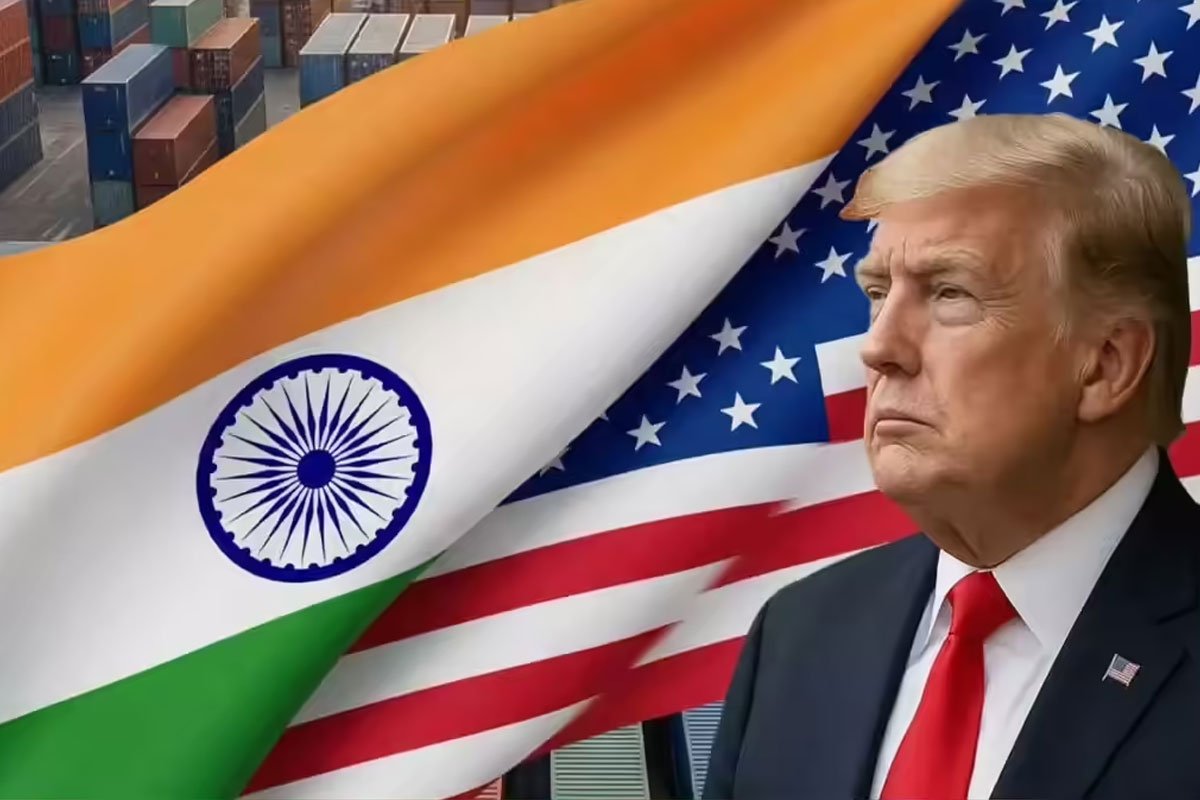
In 2025, the Indian rupee (INR) weakened significantly against the U.S. dollar (USD), impacting Indian markets. While several factors influence currency movements, a key driver was the Trump administration’s tariff strategy and deteriorating U.S.–India trade relations.
The Trigger: Trump’s Trade War
In mid-2025, the United States imposed sweeping tariffs on Indian exports, initially a 25 % reciprocal tariff and later an additional 25 % surcharge tied to India’s continued purchase of Russian oil. The combined 50 % tariff mark was one of the highest applied to any trading partner and significantly strained bilateral trade ties.
The Foreign Exchange markets are really sensitive to what’s going on in the world. When Foreign Exchange markets think that there is a lot of uncertainty about trade or that countries are being protective of their markets, investors usually look for safe places to put their money, such as the U.S. Dollar. This makes the U.S. Dollar go up in value. It makes the currencies of emerging markets, like the Indian rupee, go down in value. The Foreign Exchange markets and the U.S. Dollar are closely watched by investors when they are trying to figure out what to do with their money.
Rupee Weakens, Markets React
The USD/INR rate went up fast in 2025. At times it was close to. Even crossed the ninety rupees per dollar mark. This is because the rupee kept losing its value. The Indian rupee value fell by six to seven percent over the year. The USD/INR rate is still going up. The rupee is still losing its value.
Foreign Institutional Investors (FIIs) have pushed back on Indian equities amid uncertainty, leading to significant capital outflows.
A Reuters poll noted that portfolio outflows and risk-off sentiment, partly stemming from trade tensions, helped keep the rupee and Indian assets under pressure.
What The Experts Think: Comments From The Analysts
People who look at money and the economy think the rupee is showing signs of problems. The rupee’s move is like a warning sign that something’s not quite right with the economy. Financial analysts and economists believe the rupee’s move is a sign of stress, and this is what worries them about the rupee.
The high tariffs and the fact that we do not have a trade deal have been affecting the rupee all year. One person who tracks money going in and out of countries like India says this. They think the rupee will be worth something like eighty-five to ninety US dollars for a time, at least, until the start of 2026, before anything gets sorted out with the trade deal and the rupee.
Big changes in the USD/INR prices happen fast. This makes it very dangerous to buy and sell these currencies at the same time. The reason is that people react quickly to news headlines. They make decisions without thinking much. The USD/INR prices are affected by this. So people who trade in the term have to be very careful. The USD/INR prices can change a lot over time. This is because people are reacting to the news headlines about the USD/INR prices.
Hedging costs are really high now. This is because people are trying to fix prices for things. They want to do this because they are not sure what will happen next with hedging costs. People are worried about the future, and they want to make sure they do not lose money, so they are trying to lock in prices and manage their hedging costs.
FX forward premiums, particularly in the non-deliverable forward (NDF) markets, have climbed to multi-year highs, reflecting expectations of further INR weakness.
A lot of traders thought the price of the pair would stay between ₹80 and ₹85. Now these traders are facing losses because the price of the pair is going higher than they thought. The pair is frequently going above the levels that these traders expected.
Rising Costs for Corporates
When the Indian rupee is not doing well, Indian companies that have debt from other countries have to pay more money to service these debts. This means Indian companies have money to make a profit. It also means the value of companies goes down. Indian companies with debt are really affected by this. The weak Indian rupee is a problem for Indian companies with foreign debt.
Inflationary Pressures
When the rupee is weak, it makes the things we import from other countries more expensive. This is a problem for things like crude oil. The cost of oil goes up, and that makes a lot of other things more expensive, too. This is what we call inflation. Inflation is bad for people who buy things because they can not buy as much as they could before. So when we think about our money and how it will grow over time, we have to think about the rupee and how it affects the cost of imported goods like oil. The rupee and imported goods, like oil, are very important for our money to grow.
Strategic Uncertainty
Investors are less likely to commit new capital when macroeconomic risks are tied to external policies, in this case, U.S. trade tensions.
Recent RBI Moves and Market Balance
The Reserve Bank of India (RBI) has been actively managing volatility, including dollar sales and interventions to prevent disorderly currency moves.
The Reserve Bank of India is helping out, but people who buy and sell money for the future still think the Reserve Bank of India will have a tough time. This is because it is getting more expensive for people to protect themselves from losses, and they think the Reserve Bank of India will have to do more to help the situation.
Signs of Hope?
Despite the rough ride, not all signals are bleak:
The rupee has shown occasional rebounds, even recapturing sub-₹90 levels at times, as markets absorb news and sentiment shifts.
If the United States and India negotiations give us an idea or a new trade deal, people who study the market think things will settle down. And maybe the currency will find a more stable path. The United States and India negotiations are really important for the currency. Indian markets are at an important point right now. The Indian markets have to make some decisions. The future of markets is not clear at this time. Indian markets are standing at a crossroads.